 Affiliated under Mangalayatan University, Alighar UP



Education has always been one of the strongest foundations for building a successful career. But in today’s rapidly changing professional world, having academic knowledge alone may not always be enough.
Employers increasingly look for candidates who can apply what they know, use industry-standard tools, solve practical problems, communicate effectively, and adapt to real workplace situations.
This creates an important question:
Is traditional education enough, or do students also need industry-oriented training?
At IRIS Academy, the answer is not about choosing one over the other. It is about combining knowledge with practical skills so that students are better prepared for the professional world.
Traditional Education: Building the Foundation
Traditional education generally focuses on structured academic learning. Students learn concepts, theories, principles and subject-specific knowledge through classrooms, textbooks, examinations and assignments.
This approach is important because it helps students develop:
- Fundamental knowledge
- Theoretical understanding
- Analytical thinking
- Academic discipline
- Subject awareness
- Problem-solving abilities
However, there can sometimes be a gap between what students learn academically and what industries expect them to do professionally.
Knowing the theory of photography, for example, is different from actually handling a professional camera during a live shoot. Understanding video editing concepts is different from completing a real project under a deadline.
That is where industry-oriented training becomes valuable.
What Is Industry-Oriented Training?
Industry-oriented training focuses on learning by doing.
Instead of limiting learning to theoretical concepts, students are exposed to practical assignments, professional tools, real-world workflows and project-based learning.
The objective is simple:
Don’t just learn the subject. Learn how the subject is used in the real world.
Industry-oriented training can help students understand:
- How professional projects are planned
- How industry-standard software and equipment are used
- How teams collaborate
- How deadlines are managed
- How clients and projects are handled
- How creative ideas are converted into deliverables
- What professional standards employers expect
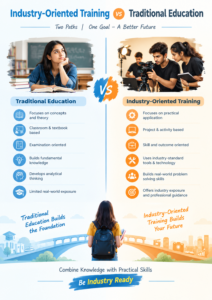
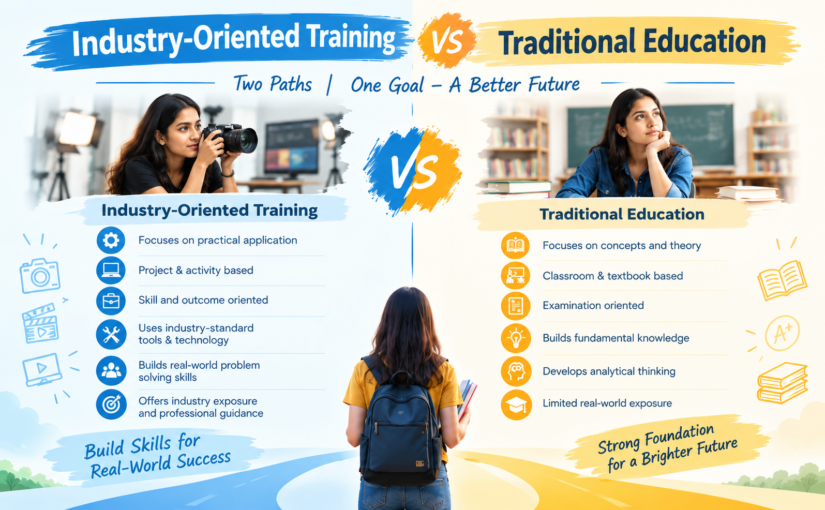
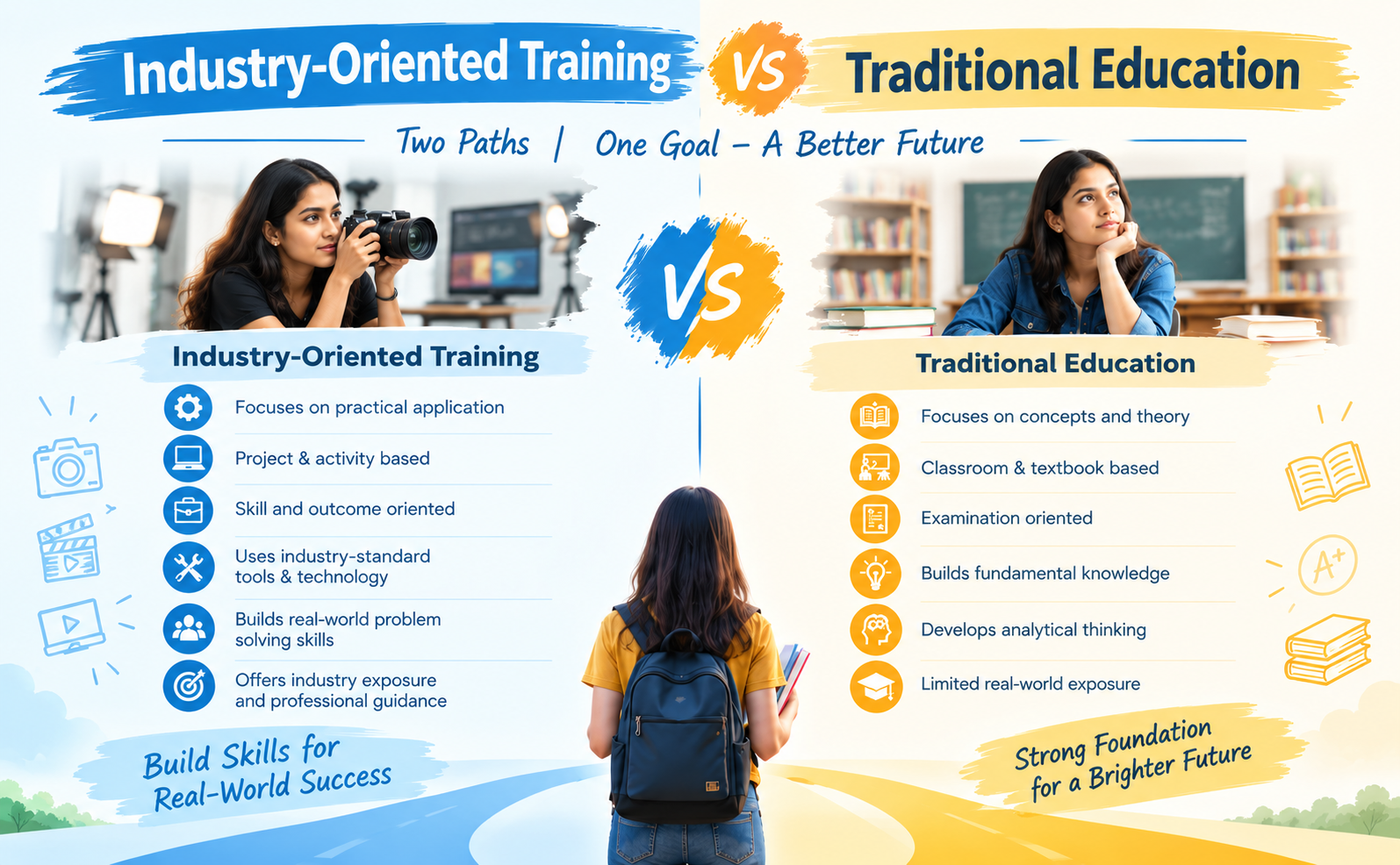
Industry-Oriented Training vs Traditional Education
| Traditional Education | Industry-Oriented Training |
|---|---|
| Focuses heavily on concepts and theory | Focuses strongly on practical application |
| Classroom and textbook based | Project and activity based |
| Examination-oriented | Skill and outcome-oriented |
| Academic assignments | Real-world style projects |
| Fixed curriculum | Adaptable to industry trends |
| Knowledge-focused | Knowledge + practical skills |
| Teacher-led learning | Mentor-guided practical learning |
| Academic evaluation | Portfolio and project evaluation |
Neither approach needs to replace the other.
A strong career-focused education can combine theoretical knowledge with practical experience.
How Does IRIS Academy Deal With This Gap?
At IRIS Academy, the focus is on creating a learning environment where students don’t simply study a subject—they get opportunities to experience how the subject works in a professional environment.
1. Learning Through Practical Projects
Instead of keeping learning limited to classroom explanations, students can work on practical assignments and projects related to their course.
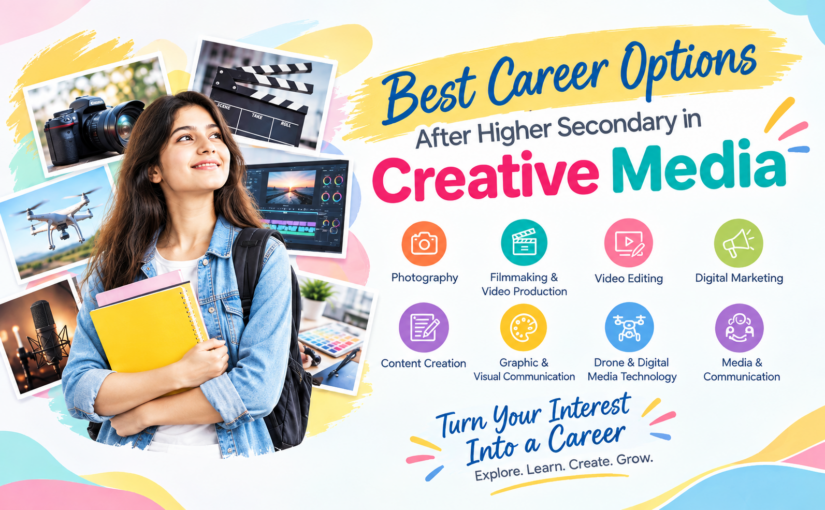
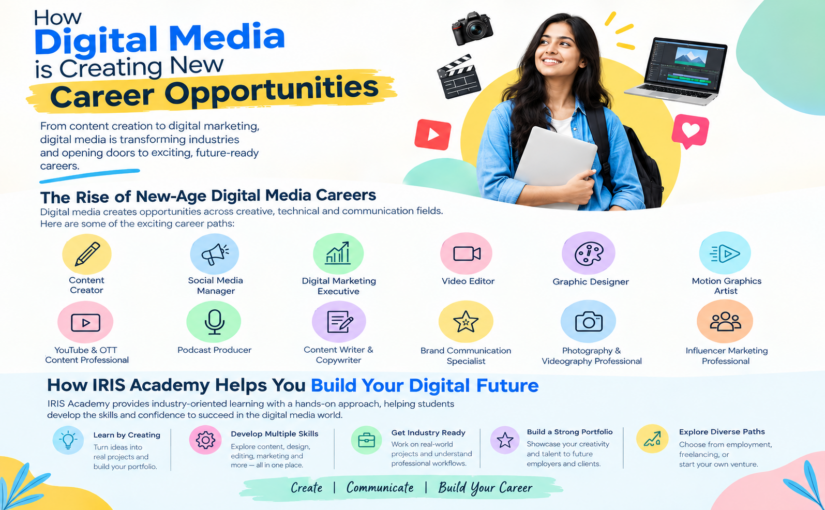
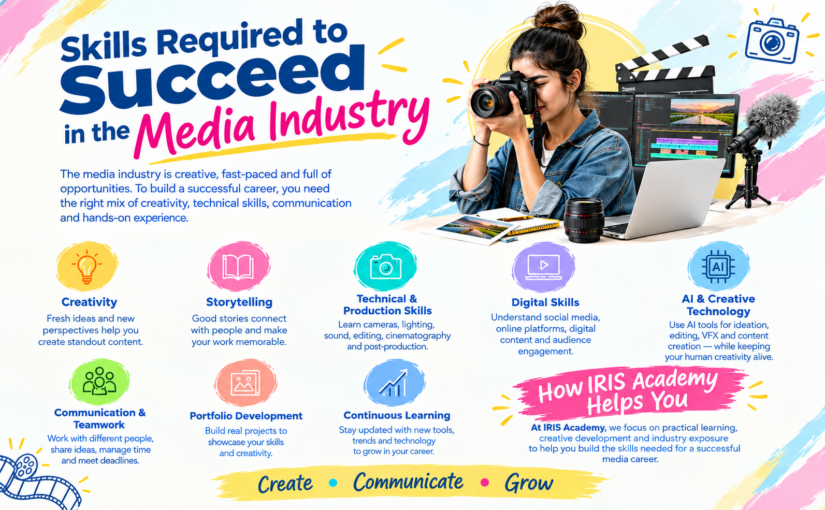
For creative and media-related subjects, this may involve activities such as photography, filmmaking, editing, design, content creation and other hands-on work.
This helps students understand how classroom concepts translate into actual projects.
2. Industry-Relevant Tools & Technology
Industries continuously evolve, particularly in areas such as media, design, photography, filmmaking, digital marketing and AI.
IRIS Academy focuses on exposing students to relevant tools, technologies and workflows so that learning remains connected with current professional practices.
The goal is not simply to teach software.
The goal is to help students understand how professionals use technology to produce real work.
3. Project-Based Learning
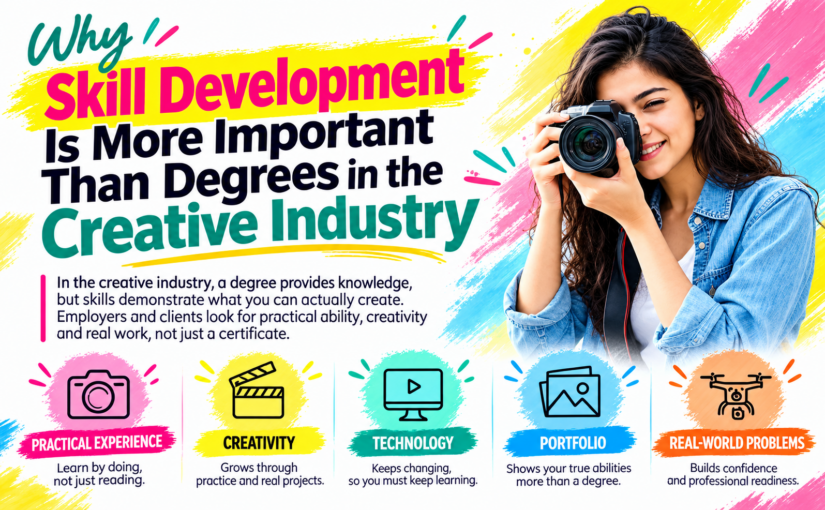
A portfolio can often demonstrate practical ability more effectively than a certificate alone.
That’s why project-based learning can play an important role in career-oriented education.
Students get opportunities to create work that can demonstrate their skills, creativity and understanding of the subject.
For example:
Learn → Practice → Create → Improve → Build a Portfolio
This approach encourages students to move from passive learning to active creation.
4. Practical Exposure
Professional environments involve more than technical skills.
Students also need to understand how projects actually operate.
At IRIS Academy, practical exposure can help students become familiar with aspects such as:
- Working with equipment
- Following production workflows
- Completing assignments within deadlines
- Working as part of a team
- Presenting creative ideas
- Taking feedback
- Improving finished work
These experiences can help students develop greater confidence before entering the workplace.
5. Mentorship and Guidance
Learning from someone who has practical experience can provide a different perspective from learning only through textbooks.
Mentors can explain not only what to do, but also why it is done that way in a professional environment.
Feedback on practical work can help students identify mistakes, improve their techniques and develop better professional habits.
6. Connecting Education With Career Goals
One of the biggest differences between academic learning and career-oriented training is the connection to a student’s future profession.
IRIS Academy aims to help students understand:
What am I learning?
↓
Where is it used?
↓
How is it used professionally?
↓
What kind of work can I create with this skill?
↓
How can I prepare for a career in this field?
This career-oriented mindset can make learning more meaningful and practical.
From Classroom to Real-World Skills
Consider a student learning photography.
Traditional learning might cover:
- Camera functions
- Exposure
- Shutter speed
- Aperture
- ISO
- Composition
These concepts are essential.
But an industry-oriented approach can take the student further:
Learn the concept → Use the camera → Conduct a shoot → Review the photographs → Edit the images → Take feedback → Improve the work → Build a portfolio
The same principle can apply to filmmaking, video editing, graphic design, digital marketing, content creation and other creative fields.
The difference is not simply what students learn.
It is also how they learn to use what they have learned.
The IRIS Academy Approach
At IRIS Academy, the objective is to create a bridge between education and employability.
The approach can be represented simply as:
KNOWLEDGE + PRACTICE + TECHNOLOGY + PROJECTS + MENTORSHIP = INDUSTRY-READY SKILLS
Students need knowledge to understand their field.
They need practice to develop their skills.
They need technology to work with modern tools.
They need projects to demonstrate what they can do.
And they need guidance to continuously improve.
When these elements come together, education becomes more connected to the realities of the professional world.
Education Should Prepare Students for What Comes Next
The world of work is changing quickly. New technologies, AI tools, digital platforms and creative workflows are changing how professionals work.
Because of this, education cannot stop at memorising information.
Students need to develop the ability to learn, practice, adapt and create.
That is the philosophy behind industry-oriented learning at IRIS Academy.
The objective is not to replace education with training.
It is to make education more practical, more relevant and more connected to real-world applications.
Conclusion
Traditional education provides the foundation.
Industry-oriented training provides opportunities to apply that foundation.
For students planning a career in creative, media, technology and other skill-based industries, combining both can create a more complete learning experience.