 Affiliated under Mangalayatan University, Alighar UP



INTRODUCTION
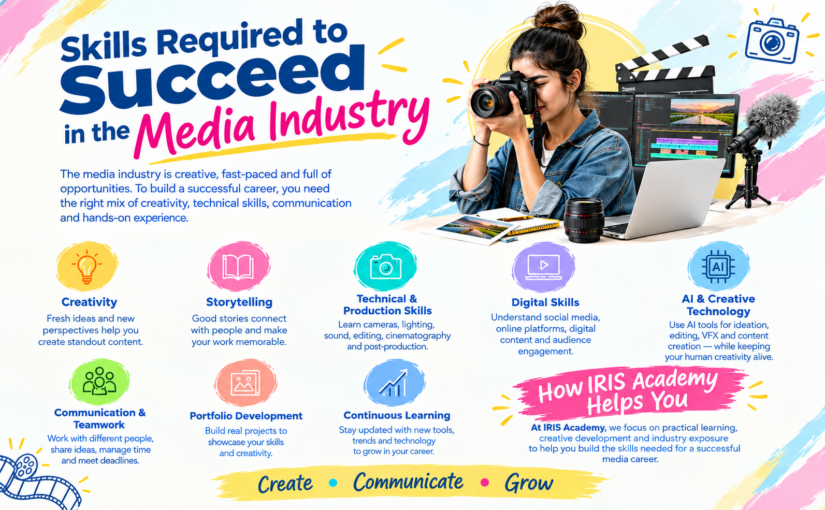
The creative industry is changing rapidly. From filmmaking and photography to video editing, cinematography, visual effects, color grading and digital content creation, today’s professionals are expected to do more than simply hold an academic qualification.
A degree can demonstrate that a student has completed a structured programme of education. But in many creative careers, employers and clients also want to see something more practical: What can you actually create?
This is where skill development becomes extremely important.
Degree vs. Skill: What Matters in the Creative Industry?
A degree can provide a strong academic foundation. It can introduce students to concepts, theories, history and structured learning. However, creative professions are highly practical.
A photographer needs to know how to use a camera and control light.
A cinematographer needs to understand framing, lenses, camera movement and lighting.
A video editor needs to understand storytelling, pacing, sound and editing software.
A colorist needs to understand color theory as well as professional color-grading workflows.
A filmmaker needs to bring together storytelling, direction, cinematography, sound, editing and production.
These abilities are developed through practice, experimentation, projects and feedback.
That is why skill development should be an essential part of creative education.
Why Practical Skills Matter
1. The Creative Industry Is Portfolio-Driven
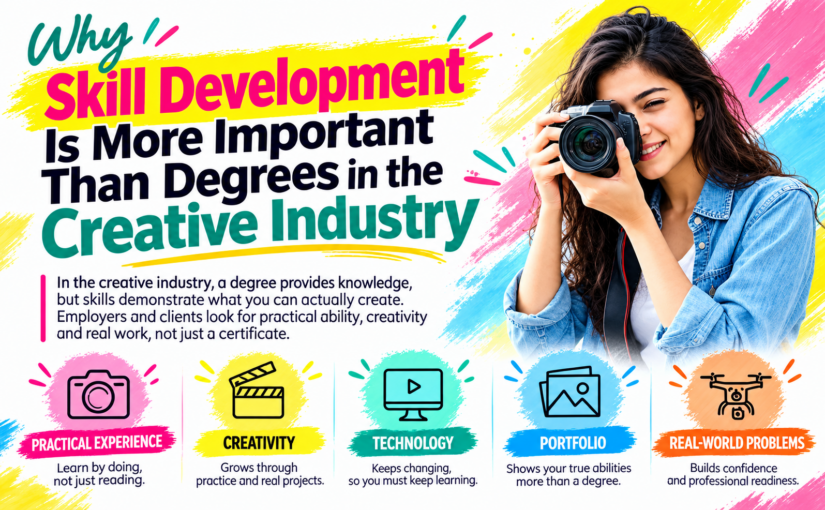
In many creative fields, a portfolio can communicate a student’s ability more directly than a certificate alone.
A strong portfolio can demonstrate:
- Photography projects
- Short films
- Music videos
- Edited videos
- Color-grading projects
- Cinematography work
- VFX and motion-graphics projects
- Social-media content
- Commercial or promotional videos
For a student entering the industry, being able to show actual work can help communicate their creative ability to potential employers, production houses and clients.
2. Technology Keeps Changing
Creative technology doesn’t remain static.
New cameras, editing software, AI tools, VFX workflows, production techniques and digital platforms continue to influence the industry.
Students therefore need to develop the ability to learn, adapt and work with new tools, rather than depending only on knowledge acquired during a degree programme.
Skill development creates a habit of continuous learning.
3. Creativity Improves Through Practice
Creativity is not developed only by reading about it.
It develops when students:
Learn → Practice → Make Mistakes → Receive Feedback → Improve → Create Again.
This practical cycle is particularly important in filmmaking, photography, editing and other production-oriented disciplines.
The more projects students complete, the more opportunities they have to understand their strengths, identify weaknesses and develop their own creative style.
4. Real Projects Teach Real Problems
Classroom exercises are useful, but real projects introduce challenges that cannot always be understood through theory alone.
For example, a student working on a video production may have to deal with:
- Limited shooting time
- Changing locations
- Lighting problems
- Equipment limitations
- Audio issues
- Team coordination
- Editing deadlines
- Client requirements
- Creative disagreements
Learning how to solve these problems is itself a professional skill.
How IRIS Academy Approaches Creative Education
At IRIS Academy – Kolkata, the approach to creative education is built around combining structured learning with practical skill development.
The objective is not simply to help students complete a course. It is to help them understand how creative skills are applied in real-world production environments.
Learning Multiple Creative Skills
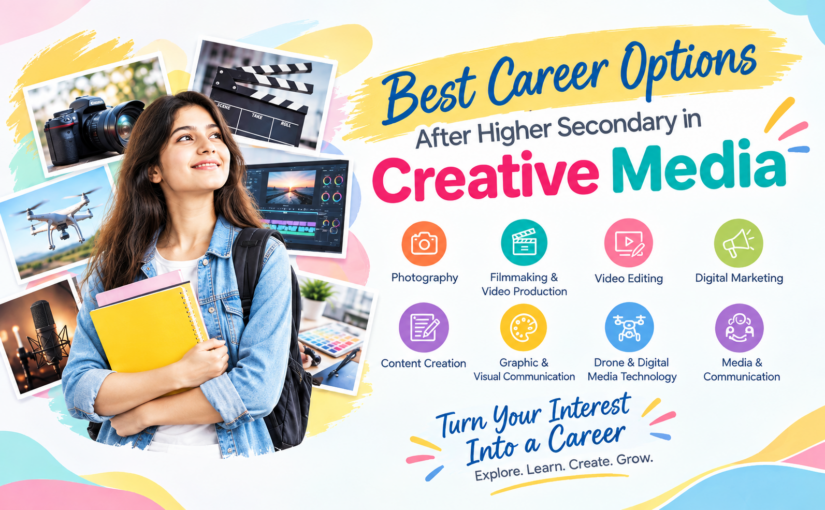
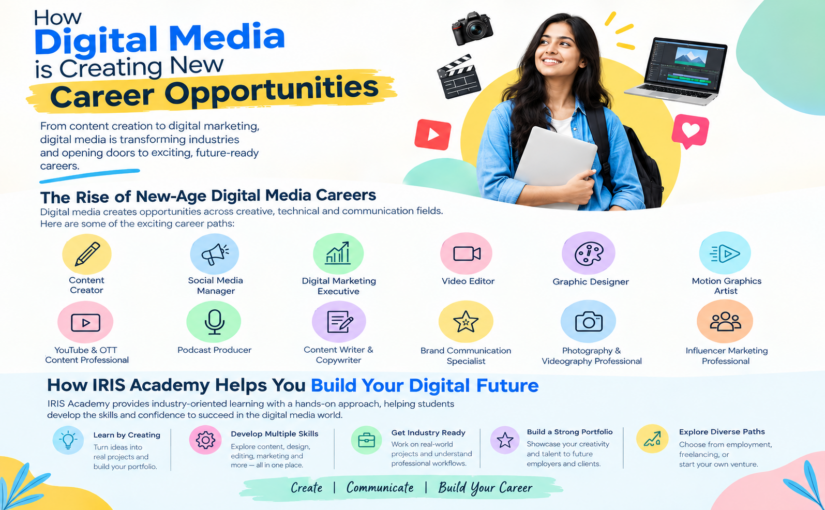
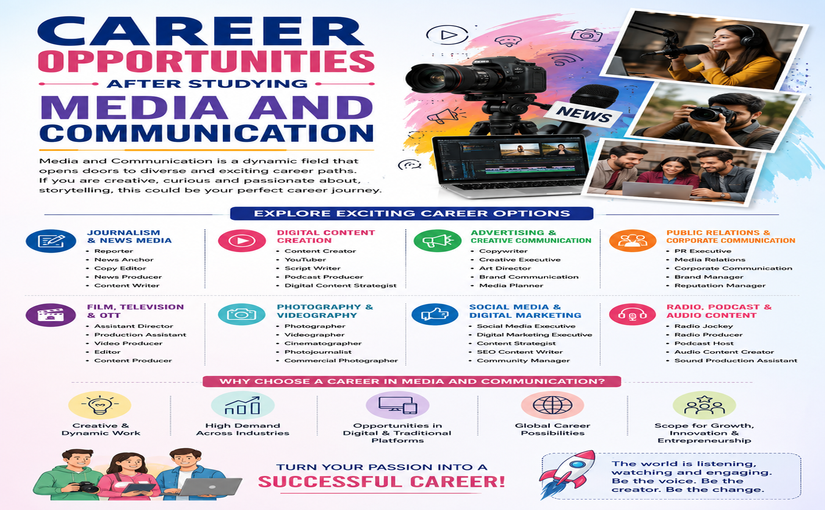
IRIS Academy provides training across several areas of the media and entertainment sector, including:
- Media Studies
- Film Studies
- Photography
- Cinematography
- Video Editing
- Photo Editing
- Color Grading
- Film Direction
- VFX & AI
- Drone Operation
- Digital Filmmaking
- Modeling
This multidisciplinary approach allows students to explore different areas of the creative industry and understand how different skills connect during production.
Practical-Oriented Learning
Creative education becomes more meaningful when students get opportunities to apply what they learn.
At IRIS Academy, practical learning can involve working on creative assignments, production exercises, photography projects, filmmaking activities, editing work and other hands-on tasks.
The goal is to move students from:
“I know about it”
to
“I can do it.”
That difference is extremely important when preparing for a creative career.
Building a Portfolio Alongside Education
One of the important outcomes of skill-based creative education is the development of a portfolio.
Instead of waiting until the end of a course to start creating work, students should gradually build a collection of projects that represents their abilities.
For example, a student specialising in photography can develop a portfolio containing portraits, fashion photography, products, events and creative photography.
A filmmaking student can develop short films, documentary exercises, music videos or other production projects.
An editing student can demonstrate different editing styles, storytelling techniques, transitions, sound design and post-production work.
A portfolio can therefore become a practical representation of the student’s learning journey.
Industry Exposure and Career Preparation
Creative careers are not developed through technical skills alone.
Students also need to understand professional expectations.
This includes:
- Communication
- Teamwork
- Time management
- Project discipline
- Professional behaviour
- Client interaction
- Portfolio presentation
- Interview preparation
- Understanding production workflows
IRIS Academy’s approach includes career guidance, portfolio support, internship-oriented exposure and interview preparation to help students understand the transition from education to professional opportunities.
Why a Combination of Degree and Skills Can Be Powerful
It is important to understand that skills and degrees do not necessarily have to be treated as alternatives.
For many students, the strongest approach can be:
Education + Practical Skills + Portfolio + Industry Exposure
A degree or diploma can provide structured education and academic grounding, while practical training helps students apply that knowledge.
For students pursuing higher education in digital filmmaking, a structured academic programme combined with practical production experience can provide a broader foundation for entering the creative sector.
The Future Belongs to Adaptable Creators
The creative industry is evolving quickly.
AI-assisted production, OTT platforms, social media, digital advertising, virtual production, advanced editing workflows and new content formats are creating new possibilities for creative professionals.
This means that students cannot stop learning after receiving a certificate or degree.
The ability to continuously develop skills may become one of the most valuable professional habits a creative person can have.
Conclusion
A degree can open an educational pathway, but skills demonstrate what a creative professional can actually do.
For careers in photography, filmmaking, cinematography, editing, color grading, VFX and digital content creation, practical ability, creativity, adaptability and portfolio development are important parts of professional preparation.